LCM Tricks and Shortcuts for Exams
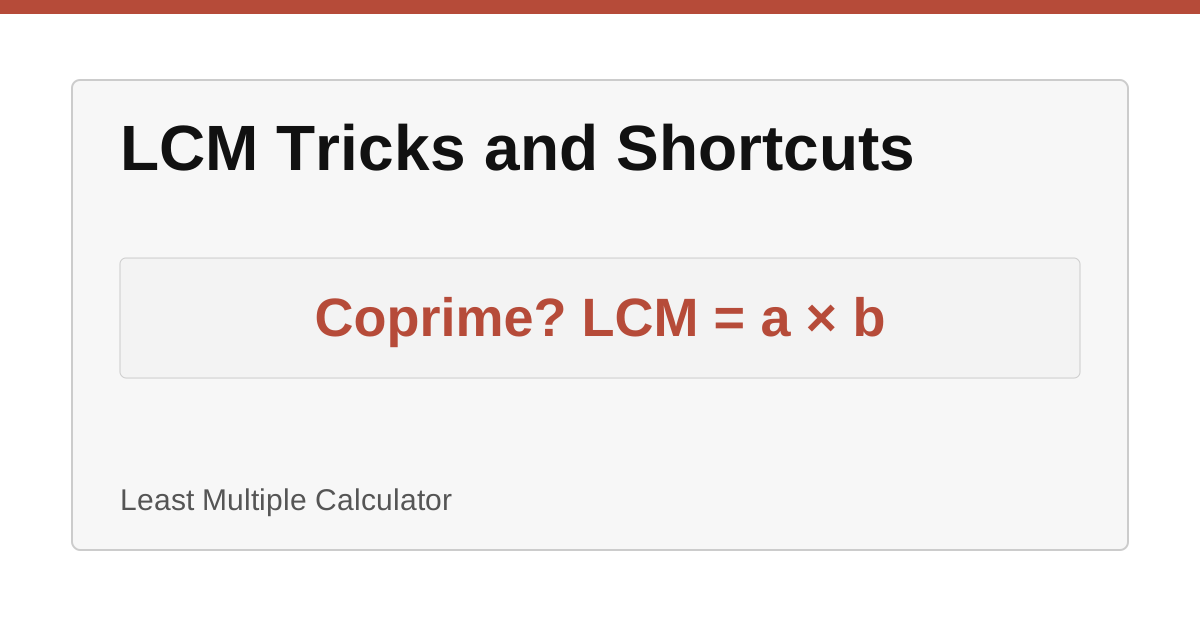
LCM tricks, the fastest first: check whether the larger number is a multiple of the smaller one. If it is, the larger number is the LCM. If it is not, multiply the larger number by 2, 3, 4… and stop at the first result the smaller number divides. LCM(8, 12): 12 → no, 24 → yes, so 24.
Every trick below is a shortcut for one of the four methods on How to find the LCM. None of them replaces knowing prime factorization; they save time when the numbers are small or share an obvious factor. Times are not claimed; speed depends on the numbers.
Trick 1: The multiple test
Count up in multiples of the larger number until the smaller number divides one. LCM(9, 12): 12, 24, 36 → 9 divides 36, so LCM = 36. Works mentally up to about 50.
Trick 2: Coprime numbers → multiply
If the two numbers share no factor (HCF = 1), the LCM is their product. LCM(7, 9) = 63; LCM(8, 15) = 120. Quick test: consecutive numbers, two different primes, or an odd and a power of 2 are always coprime.
Trick 3: One divides the other → the larger number
If the smaller number divides the larger, the larger number is the LCM. LCM(6, 18) = 18; LCM(5, 40) = 40. Also LCM(1, n) = n.
Trick 4: The HCF formula in your head
LCM = a × b ÷ HCF(a, b)
Spot the HCF by eye, divide one number by it, multiply by the other. LCM(15, 25): HCF 5 → 15 ÷ 5 = 3 → 3 × 25 = 75. LCM(14, 21): HCF 7 → 2 × 21 = 42. Dividing first keeps the arithmetic small.
Trick 5: The division table for three or more numbers
Write the numbers in a row and divide by small primes, carrying down what does not divide. It is the method examiners expect and it scales to any count. Worked on the division method page.
Division method: LCM(12, 18, 30)
Divide the row by the smallest prime that goes into at least one number; carry the rest down. Keep going until every number becomes 1. The LCM is the product of all the divisors on the left.
| 2 | 12 | 18 | 30 |
|---|---|---|---|
| 2 | 6 | 9 | 15 |
| 3 | 3 | 9 | 15 |
| 3 | 1 | 3 | 5 |
| 5 | 1 | 1 | 5 |
| 1 | 1 | 1 |
LCM = 2 × 2 × 3 × 3 × 5 = 2² × 3² × 5 = 180
LCM(12, 18, 30) = 180
When the LCM tricks fail
- The multiple test slows down when the LCM is much larger than both numbers: LCM(36, 48) = 144 takes three steps; prime factorization (144 = 2⁴ × 3²) is quicker.
- The coprime rule fails when a factor is hidden: 21 and 35 look unrelated but share 7, so LCM = 105, not 735.
- The HCF formula holds for two numbers only. For three, chain it or use the table.
Drill: ten LCM questions
- LCM(6, 8)
answer
= 24 (HCF 2) - LCM(9, 12)
answer
= 36 (HCF 3) - LCM(4, 10)
answer
= 20 (HCF 2) - LCM(7, 9)
answer
= 63 (HCF 1) - LCM(15, 25)
answer
= 75 (HCF 5) - LCM(8, 20)
answer
= 40 (HCF 4) - LCM(14, 21)
answer
= 42 (HCF 7) - LCM(5, 12)
answer
= 60 (HCF 1) - LCM(18, 24)
answer
= 72 (HCF 6) - LCM(16, 36)
answer
= 144 (HCF 4)
Which trick applies: 6 and 8 → multiple test; 7 and 9 → coprime; 4 and 10 → HCF formula; 5 and 12 → coprime; 18 and 24 → HCF formula. More practice on LCM questions by class.
Frequently asked questions
What is the easiest way to find the LCM?
Check whether the larger number is a multiple of the smaller one. If yes, the larger number is the LCM: LCM(6, 18) = 18. If no, multiply the larger number by 2, 3, 4… until the result is divisible by the smaller number.
What is the fastest way to find the LCM of two numbers?
For numbers that share no factor, multiply them: LCM(7, 9) = 63. Otherwise divide the product by the HCF: LCM(9, 12) = 9 × 12 ÷ 3 = 36. Both take one line.
Is there a trick to find the LCM mentally?
Yes: count up in multiples of the larger number and stop at the first one the smaller number divides. For 8 and 12: 12, 24 → 8 divides 24, so LCM = 24. It needs no writing for numbers under 50.
What is the LCM short trick for competitive exams?
Use the division table for three or more numbers, and the HCF formula for two. Also memorise the small LCMs (2 to 12) from the LCM table; most aptitude questions reuse them.
How do I find the LCM quickly for large numbers?
Prime factorization with the highest powers, or the HCF formula after a two-step Euclidean algorithm. Listing multiples is the slow method for large numbers.
Can the LCM be found in a few seconds?
For small numbers, the multiple test gives the LCM in one step. No fixed time applies to every pair; larger numbers need a division table or prime factorization.
How do I check my LCM answer fast?
Divide the answer by each original number; every division must be exact. Then confirm no smaller common multiple exists by checking half the answer is not one.
What is the easiest way to learn the LCM?
Start with listing multiples on numbers up to 12, then learn prime factorization once. Every other trick is a shortcut for one of those two methods.
Sources
- Wikipedia: Least common multiple: definition, notation, LCM × GCD = a × b
- Wolfram MathWorld: Least Common Multiple: formal properties
- Common Core 6.NS.B.4: GCF and LCM in grade 6