What is the least common multiple?
The least common multiple (LCM) of two or more whole numbers is the smallest positive number that all of them divide into exactly. LCM(12, 15, 75) = 300. Use the least multiple calculator above to get it for your own numbers.
It is also called the lowest common multiple or the smallest common multiple, and when the numbers are the denominators of fractions, the least common denominator (LCD). You need it to add or subtract fractions, to line up repeating events (two buses every 12 and 15 minutes meet again after 60), and in algebra and number theory.
The related idea is the greatest common factor (GCF, also GCD or HCF): the largest number that divides into all of them. For two numbers the pair are linked by LCM × GCF = a × b.
How to find the LCM with the least multiple calculator
The calculator shows each of these for your own numbers. Pick one under “Show the working”.
How to read your result
The answer card shows more than one number. Here is what each line means, using the example LCM(12, 15, 75) = 300.
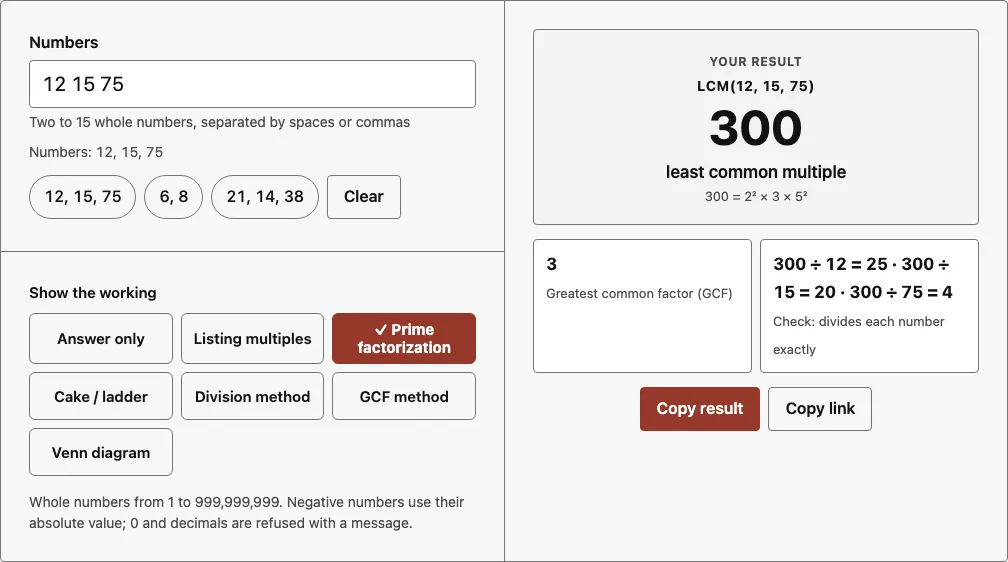
- The big number is the least common multiple: the smallest positive whole number that every number you entered divides exactly.
- The line under it writes the LCM as prime powers, for example 300 = 2² × 3 × 5². These are the highest power of each prime found in any of your numbers.
- Greatest common factor (GCF) is the largest number that divides all of your numbers. It comes from the same prime factors, using the lowest shared powers.
- Check divides the LCM by each of your numbers. Every result is a whole number, which proves the answer is a common multiple.
- Show the working switches the step-by-step box between six methods: listing multiples, prime factorization, cake (ladder), division, GCF and Venn diagram. The answer is the same in every method.
- Copy result copies the answer as text; Copy link copies a web address that reopens the calculator with the same numbers.
How to find the LCM by listing multiples
Write out the multiples of each number until the same one appears in every list. For 18, 26:
Write out the multiples of each number until one multiple appears in every row. The first number that appears in all rows is the least common multiple.
234 is the first multiple shared by every number.
LCM(18, 26) = 234
LCM(18, 26) = 234. It works, but for larger numbers the lists get very long, so use one of the methods below.
How to find the LCM by prime factorization
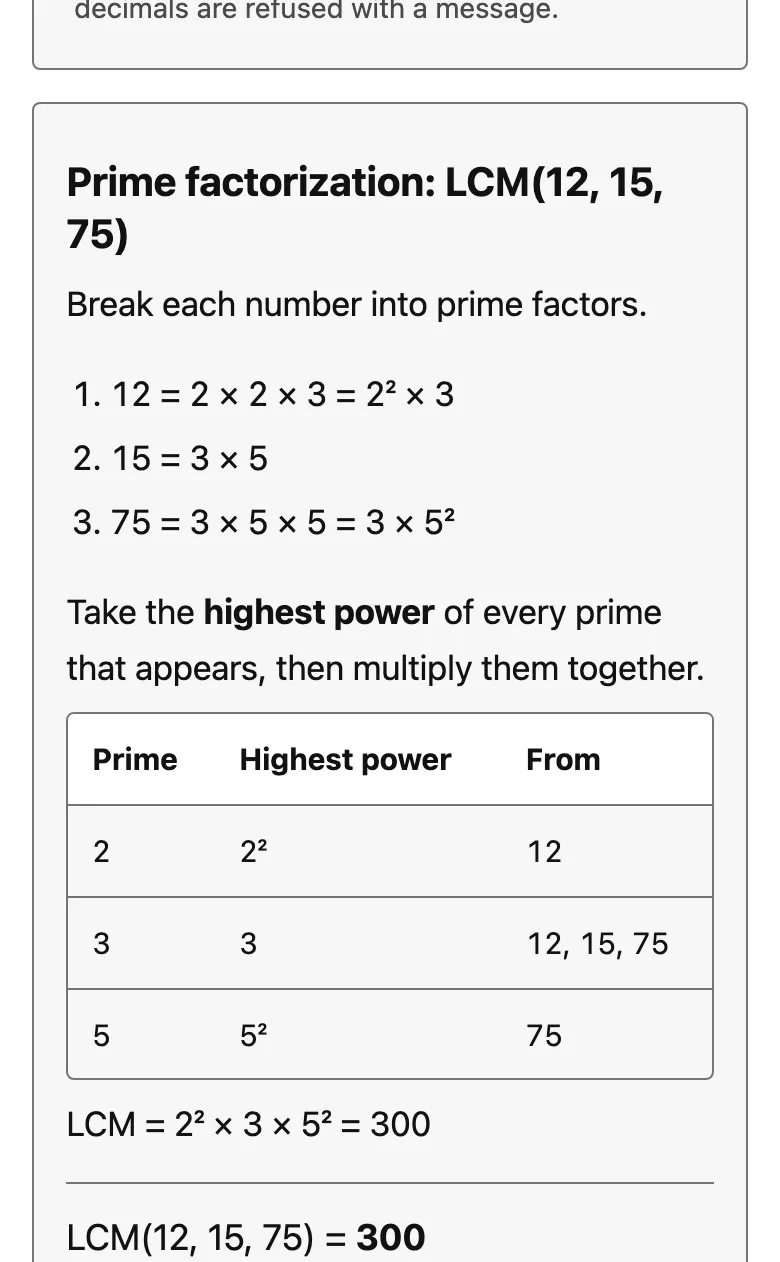
Break each number into prime factors, take the highest power of every prime that appears, and multiply. For 12, 15, 75:
Break each number into prime factors.
- 12 = 2 × 2 × 3 = 2² × 3
- 15 = 3 × 5
- 75 = 3 × 5 × 5 = 3 × 5²
Take the highest power of every prime that appears, then multiply them together.
| Prime | Highest power | From |
|---|---|---|
| 2 | 2² | 12 |
| 3 | 3 | 12, 15, 75 |
| 5 | 5² | 75 |
LCM = 2² × 3 × 5² = 300
LCM(12, 15, 75) = 300
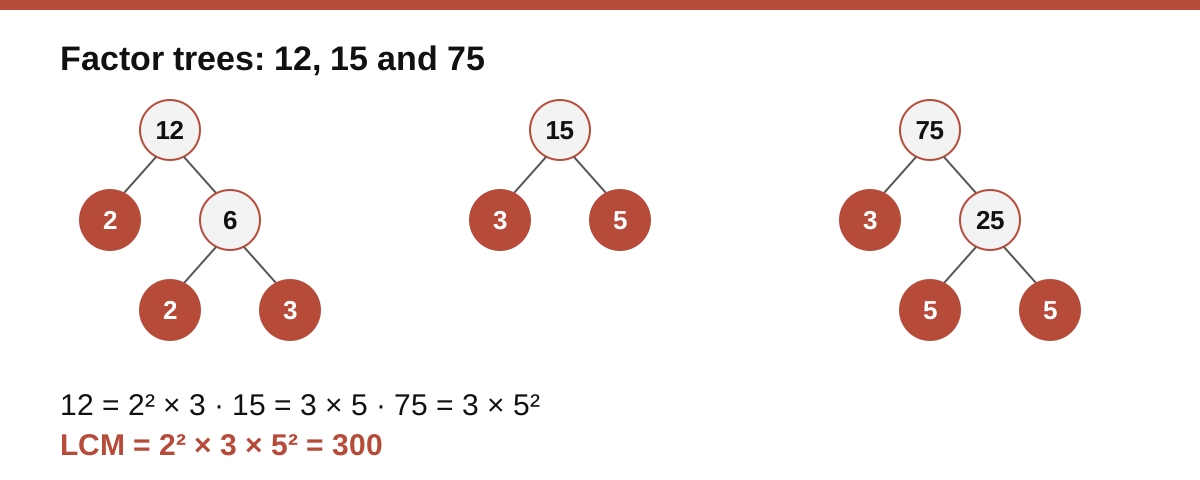
Highest powers: 2² × 3 × 5² = 300. This is the method to learn: it works for any amount of numbers and any size.
How to find the LCM by prime factorization using exponents
Write each of 12, 15, 75 as a product of primes with exponents, then line the primes up in a grid. The LCM takes the highest exponent of every prime, whichever number it comes from.
| Number | 2 | 3 | 5 |
|---|---|---|---|
| 12 | ✓ 22 | ✓ 31 | 50 |
| 15 | 20 | ✓ 31 | 51 |
| 75 | 20 | ✓ 31 | ✓ 52 |
| Highest exponent | 22 | 31 | 52 |
LCM = 2² × 3 × 5² = 300
Reading down each column and keeping the largest exponent is the whole method, and it is why prime factorization works for any amount of numbers of any size.
- A prime that is missing from a number has exponent 0, so it never lowers the LCM.
- Keeping the lowest exponent in each shared column gives the GCF instead.
- If no column has two non-zero exponents, the numbers are coprime and the LCM is their product.
How to find the LCM using the cake method (ladder method)
Write the numbers in a row and divide by a prime that goes into at least two of them, carrying the others down. Repeat until nothing is shared. Multiply the divisors on the left by the numbers left at the bottom. For 12, 15, 75: divide by 3, 5; the bottom row is 4, 1, 5; LCM = 3 × 5 × 4 × 1 × 5 = 300.
Write the numbers in a row. Divide by a prime that goes into at least two of them; numbers it does not divide are carried down unchanged. Repeat until no prime divides two or more numbers.
| 3 | 12 | 15 | 75 |
|---|---|---|---|
| 5 | 4 | 5 | 25 |
| 4 | 1 | 5 |
Multiply the divisors on the left by the numbers left in the bottom row:
LCM = 3 × 5 × 4 × 1 × 5 = 300
LCM(12, 15, 75) = 300
How to find the LCM using the division method
Like the cake method, but you divide by the smallest prime that goes into any number and keep going until every number is 1. The LCM is the product of all the divisors. It is the same arithmetic as prime factorization, laid out as a table.
Divide the row by the smallest prime that goes into at least one number; carry the rest down. Keep going until every number becomes 1. The LCM is the product of all the divisors on the left.
| 2 | 12 | 15 | 75 |
|---|---|---|---|
| 2 | 6 | 15 | 75 |
| 3 | 3 | 15 | 75 |
| 5 | 1 | 5 | 25 |
| 5 | 1 | 1 | 5 |
| 1 | 1 | 1 |
LCM = 2 × 2 × 3 × 5 × 5 = 2² × 3 × 5² = 300
LCM(12, 15, 75) = 300
How to find the LCM by GCF
For two numbers, LCM(a, b) = a × b ÷ GCF(a, b). For more numbers, chain it: LCM of the first two, then LCM of that result and the next. For 21, 14, 38:
For two numbers, LCM(a, b) = a × b ÷ GCF(a, b). With more numbers, find the LCM of the first two, then the LCM of that answer and the next number, and so on.
- GCF(21, 14) = 7, so LCM(21, 14) = 21 × 14 ÷ 7 = 294 ÷ 7 = 42
- GCF(42, 38) = 2, so LCM(42, 38) = 42 × 38 ÷ 2 = 1,596 ÷ 2 = 798
LCM(21, 14, 38) = 798
LCM(21, 14, 38) = 798.
The greatest common factor (GCF) is the same as:
- HCF, the highest common factor (UK and India)
- GCD, the greatest common divisor (mathematics texts)
- HCD, the highest common divisor
How to find the LCM using Venn diagrams
Put the prime factors of each number in a circle, with shared factors in the overlap written once. Multiplying every factor in the diagram gives the LCM; the overlap alone gives the GCF. It works for two or three numbers and is a good way to see why LCM × GCF = a × b.
Put each number's prime factors in its circle. Factors shared by two (or three) numbers go where the circles overlap, written once. Multiply every factor in the diagram to get the LCM; the overlap alone gives the GCF.
LCM = 2 × 2 × 5 × 5 × 3 = 300
GCF = 3 (the middle region) = 3
LCM(12, 15, 75) = 300
Which method should I use?
Use prime factorization unless the numbers are small, in which case listing multiples is quicker to write down. Use the GCF formula when you already know the GCF, and the ladder when your class expects a table.
| Method | Best for | Numbers | Shows the GCF too |
|---|---|---|---|
| Listing multiples | Small numbers, first lessons | 2 or 3 | No |
| Prime factorization | Any numbers, showing the method | Any | Yes (shared primes, lowest power) |
| Cake / ladder | Classes that teach the ladder | 2 to 5 | Yes (the left column) |
| Division method | Indian and UK syllabuses | Any | No |
| GCF formula | Two numbers when the GCF is known | 2 (chained for more) | Uses it |
| Venn diagram | Seeing why LCM × GCF = a × b | 2 or 3 | Yes (the overlap) |
LCM formula
LCM(a, b) = a × b ÷ GCF(a, b)
For more than two numbers there is no single formula; use prime factorization or chain the two-number formula. The LCM is never smaller than the largest number and never larger than their product; LCM(1, n) = n.
How to find the LCM of decimal numbers
- Multiply every decimal by 10, 100 or 1,000 until all of them are whole numbers, using the same power of 10 for all.
- Find the LCM of those whole numbers with any method above.
- Divide that LCM by the same power of 10.
For 0.6, 0.4: multiply by 10 to get 6, 4; LCM = 12; divide by 10 → 1.2.
Multiply decimals by 10, 100 or 1,000 until they are whole numbers, find the LCM, then divide back: LCM(0.5, 2.5) → LCM(5, 25) = 25 → 2.5. For fractions, the LCM of fractions is the LCM of the numerators over the HCF of the denominators, and the number used to add fractions is the LCD from the Least Common Denominator Calculator. Both are worked through on LCM of fractions and decimals.
Properties of the LCM
These rules hold for any positive whole numbers. Each card states the rule and checks it with real numbers.
The LCM is associative
LCM(a, LCM(b, c)) = LCM(LCM(a, b), c): pair three numbers in any order and the LCM does not change.
LCM(4, LCM(6, 8)) = LCM(4, 24) = 24
LCM(LCM(4, 6), 8) = LCM(12, 8) = 24
The LCM is commutative
LCM(a, b) = LCM(b, a): the order of the numbers does not matter.
LCM(6, 8) = 24
LCM(8, 6) = 24
The LCM is distributive
LCM(a, GCF(b, c)) = GCF(LCM(a, b), LCM(a, c)): the LCM distributes over the greatest common factor.
LCM(4, GCF(6, 10)) = LCM(4, 2) = 4
GCF(LCM(4, 6), LCM(4, 10)) = GCF(12, 20) = 4
The LCM is related to the greatest common factor (GCF)
LCM(a, b) × GCF(a, b) = a × b for any two numbers, so knowing one gives the other. If GCF(a, b) = 1, the LCM is simply a × b.
LCM(12, 18) × GCF(12, 18) = 36 × 6 = 216
12 × 18 = 216
LCM of a range: 1 to 10 and 1 to 20
LCM(1 to 10) = 2,520 = 2³ × 3² × 5 × 7. LCM(1 to 20) = 232,792,560 = 2⁴ × 3² × 5 × 7 × 11 × 13 × 17 × 19.
For a range, take every prime up to the top number at the highest power that still fits in the range: for 1 to 10, 2³ = 8, 3² = 9, 5 and 7. Enter any list of up to 15 numbers in the calculator to get the LCM of a range or a set.
LCM table for 1 to 12
| × | 1 | 2 | 3 | 4 | 5 | 6 | 7 | 8 | 9 | 10 | 11 | 12 |
|---|---|---|---|---|---|---|---|---|---|---|---|---|
| 1 | 1 | 2 | 3 | 4 | 5 | 6 | 7 | 8 | 9 | 10 | 11 | 12 |
| 2 | 2 | 2 | 6 | 4 | 10 | 6 | 14 | 8 | 18 | 10 | 22 | 12 |
| 3 | 3 | 6 | 3 | 12 | 15 | 6 | 21 | 24 | 9 | 30 | 33 | 12 |
| 4 | 4 | 4 | 12 | 4 | 20 | 12 | 28 | 8 | 36 | 20 | 44 | 12 |
| 5 | 5 | 10 | 15 | 20 | 5 | 30 | 35 | 40 | 45 | 10 | 55 | 60 |
| 6 | 6 | 6 | 6 | 12 | 30 | 6 | 42 | 24 | 18 | 30 | 66 | 12 |
| 7 | 7 | 14 | 21 | 28 | 35 | 42 | 7 | 56 | 63 | 70 | 77 | 84 |
| 8 | 8 | 8 | 24 | 8 | 40 | 24 | 56 | 8 | 72 | 40 | 88 | 24 |
| 9 | 9 | 18 | 9 | 36 | 45 | 18 | 63 | 72 | 9 | 90 | 99 | 36 |
| 10 | 10 | 10 | 30 | 20 | 10 | 30 | 70 | 40 | 90 | 10 | 110 | 60 |
| 11 | 11 | 22 | 33 | 44 | 55 | 66 | 77 | 88 | 99 | 110 | 11 | 132 |
| 12 | 12 | 12 | 12 | 12 | 60 | 12 | 84 | 24 | 36 | 60 | 132 | 12 |
Common mistakes
- Lowest power instead of highest. 12 = 2² × 3, 18 = 2 × 3². The LCM uses 2² and 3² (36). The lowest powers give the GCF (6).
- Multiplying every number. 12 × 18 = 216 is a common multiple, not the least one.
- Stopping the division table early. Keep dividing until every entry is 1.
- Confusing LCM with GCF. The GCF is never larger than the numbers; the LCM is never smaller.
Where the LCM is used
- Adding fractions: 1/12 + 1/15 uses the LCD 60, the LCM of 12 and 15.
- Repeating events: buses every 12 and 15 minutes leave together again after 60 minutes; two gears with 12 and 18 teeth realign after 36 teeth pass.
- Schedules and tiling: the smallest square tiled by 6 × 8 rectangles has side 24, the LCM of 6 and 8.
Real-life LCM problems
The LCM answers any question of the form "when do these line up again?" Five short examples, each worked with the calculator:
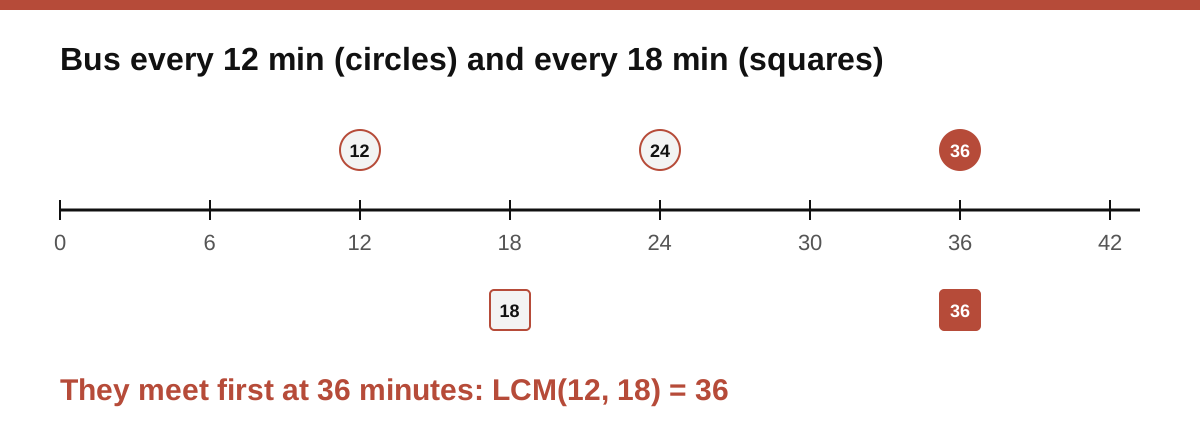
- Bus timetable: one bus leaves every 12 minutes and another every 18 minutes. Both leave together at 8:00. LCM(12, 18) = 36, so they leave together again after 36 minutes, at 8:36.
- Square tiles: the smallest square you can fill with 8 cm tiles in one row and 12 cm tiles in another, with both rows ending flush, is 24 cm wide. LCM(8, 12) = 24.
- Blinking lights: three lights blink every 4, 6, 10 seconds. They blink together every LCM(4, 6, 10) = 60 seconds.
- Adding fractions: 1/4 + 1/6. The least common denominator is LCM(4, 6) = 12, so 1/4 + 1/6 = 3/12 + 2/12 = 5/12.
- Buying in packs: rolls come in packs of 6 and sausages in packs of 8. To have the same number of each with none left over, buy 24 of each: 4 packs of rolls and 3 packs of sausages.
More worked problems, with the full working, are on the LCM word problems page.
GCF and LCM together
The answer card above shows the greatest common factor next to the LCM for every calculation, because the two are found from the same prime factors and are linked by LCM × GCF = a × b for any two numbers: for 18, 26, 234 × 2 = 468 = 18 × 26.
Why use this least multiple calculator
- 2 to 15 numbers at once, each up to 999,999,999, typed with spaces or commas in any order.
- Six methods of working, written the way textbooks set them out, so you can check homework against the method your class uses.
- GCF and a check line with every answer, so you can see the result is right without trusting it.
- Exact answers: very large results are calculated with whole-number arithmetic, never rounded.
- Free, with no sign-up, and a shareable link for every calculation.
- 15 languages, with the same calculator and the same worked methods in each.
- Tested code: the calculator and every number printed on this page come from the same functions, covered by automated tests. See how we check our pages.
Frequently asked questions
What is the LCM of two prime numbers?
Their product. Prime numbers share no factors, so LCM(7, 11) = 77. The same is true of any two numbers with a GCF of 1, such as 8 and 9 (LCM = 72).
Is the LCM the same as the lowest common multiple or the least common denominator?
Lowest common multiple is the same thing (the UK term). The least common denominator (LCD) is the LCM of the denominators of two or more fractions, used to add or subtract them: to add 1/12 and 1/15 you use 60, the LCM of 12 and 15.
What is the least multiple?
The least multiple of a single number is the number itself (the least multiple of 6 is 6). The phrase usually means the least common multiple of two or more numbers: the smallest number they all divide into. LCM(6, 8) = 24.
How do I calculate the LCM and HCF together?
Factor each number into primes. The LCM takes every prime at its highest power; the HCF (GCF) takes the shared primes at their lowest power. For 12 and 18: LCM = 2² × 3² = 36, HCF = 2 × 3 = 6, and 36 × 6 = 216 = 12 × 18.
How is the LCM calculated step by step?
Step 1: write each number as a product of primes. Step 2: list every prime that appears. Step 3: take each prime at the highest power it reaches in any number. Step 4: multiply those powers. For 12, 15, 75: 12 = 2² × 3, 15 = 3 × 5, 75 = 3 × 5²; highest powers 2² × 3 × 5²; LCM = 300. Choose "Prime factorization" above to see these four steps for your numbers.
Can I share or save a calculation?
Yes. Every calculation has its own link, for example ?n=12,15,75&m=primes. Click "Copy link" under the result and paste it anywhere; opening it shows the same numbers and working.
Summary
The least multiple calculator gives the least common multiple of 2 to 15 whole numbers and shows the working by listing multiples, prime factorization, the cake method, division, the GCF formula or a Venn diagram. For two numbers, LCM = a × b ÷ GCF; for more numbers, take every prime at its highest power. Use the result to add fractions, line up repeating events, or check your homework.
Cite this calculator
APA: Least Multiple Calculator. (2026). Least Multiple Calculator. Retrieved 2026-11-02, from https://leastmultiplecalculator.com/
<a href="https://leastmultiplecalculator.com/">Least Multiple Calculator</a>References
- Wikipedia, Least common multiple: definition, notation, the relation LCM × GCD = a × b, applications.
- Wolfram MathWorld, Least Common Multiple: formal properties.
- Common Core State Standards, 6.NS.B.4: GCF and LCM in grade 6.