LCM of Fractions and Decimals (LCD)
The LCM of fractions equals the LCM of the numerators divided by the HCF of the denominators. LCM(2/3, 4/9) = LCM(2, 4) ÷ HCF(3, 9) = 4 ÷ 3 = 4/3. To add fractions, use the LCM of the denominators instead, called the lowest common denominator (LCD).
Two different questions hide behind "LCM of fractions". Homework in class 5 to 7 usually means the fraction formula below. Adding or subtracting fractions means the LCD. Both are explained here; the LCM Calculator finds the whole-number LCMs each one needs.
Formula: LCM of fractions
LCM(a/b, c/d) = LCM(a, c) ÷ HCF(b, d)
Reduce each fraction first. The result is the smallest fraction that both fractions divide into a whole number of times: 4/3 ÷ 2/3 = 2 and 4/3 ÷ 4/9 = 3.
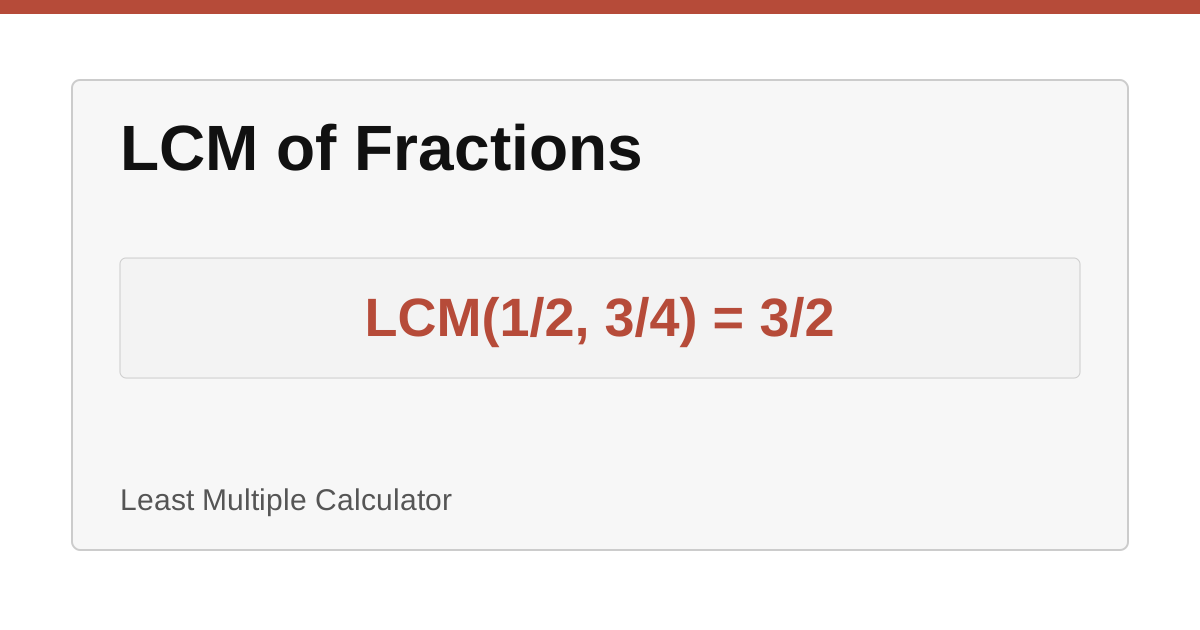
Worked example: LCM of 1/2 and 3/4
- Numerators 1 and 3: LCM(1, 3) = 3.
- Denominators 2 and 4: HCF(2, 4) = 2.
- LCM(1/2, 3/4) = 3 ÷ 2 = 3/2. Check: 3/2 ÷ 1/2 = 3 and 3/2 ÷ 3/4 = 2.
How do you find the HCF and LCM of fractions?
The HCF of fractions turns the formula upside down: HCF(a/b, c/d) = HCF(a, c) ÷ LCM(b, d). For 2/3 and 4/9: HCF(2, 4) ÷ LCM(3, 9) = 2 ÷ 9 = 2/9. The whole-number HCF and LCM are explained on greatest common divisor / GCF / HCF.
| Numerators | Denominators | |
|---|---|---|
| LCM of fractions | LCM | HCF |
| HCF of fractions | HCF | LCM |
Lowest common denominator: adding fractions
The LCD is the LCM of the denominators. For 1/12 + 1/15, LCD = LCM(12, 15) = 60.
- 1/12 = 5/60 and 1/15 = 4/60.
- 1/12 + 1/15 = 9/60 = 3/20 after dividing by the HCF 3.
The LCD is never the numerator formula. Adding uses only the denominators. For any set of fractions, the least common denominator calculator gives the LCD, rewrites each fraction and adds them. The definition of the LCM itself is on What is the LCM.
LCM of decimals
Multiply every decimal by 10, 100 or 1000 until all are whole numbers, find the LCM, and divide back. LCM(0.5, 2.5): ×10 gives 5 and 25, LCM(5, 25) = 25, so LCM(0.5, 2.5) = 2.5. LCM(0.25, 0.4): ×100 gives 25 and 40, LCM = 200, so the answer is 2.
Mixed numbers
Convert to improper fractions first. LCM(1½, 2¼) = LCM(3/2, 9/4) = LCM(3, 9) ÷ HCF(2, 4) = 9 ÷ 2 = 4½.
LCM fraction questions for class 5
- LCM of 1/3 and 1/6 → LCM(1, 1) ÷ HCF(3, 6) = 1/3.
- LCM of 2/5 and 3/10 → LCM(2, 3) ÷ HCF(5, 10) = 6/5.
- LCD of 1/4, 1/6 and 1/8 → LCM(4, 6, 8) = 24.
- HCF of 4/9 and 8/15 → HCF(4, 8) ÷ LCM(9, 15) = 4/45.
Fractions with variables
For algebraic fractions such as 1/(x+2) and 1/(x−1), the LCD is the product of the distinct factors, (x+2)(x−1), with any repeated factor taken at its highest power. The whole-number rules carry over to polynomials factor by factor.
Frequently asked questions
How do you find the LCM of fractions?
LCM of fractions = LCM of the numerators ÷ HCF of the denominators. LCM(2/3, 4/9) = LCM(2, 4) ÷ HCF(3, 9) = 4 ÷ 3 = 4/3.
How do you find the HCF of fractions?
HCF of fractions = HCF of the numerators ÷ LCM of the denominators. HCF(2/3, 4/9) = HCF(2, 4) ÷ LCM(3, 9) = 2 ÷ 9 = 2/9.
Do you find the LCM when adding fractions?
Yes. To add fractions with different denominators, find the LCM of the denominators, called the lowest common denominator (LCD). For 1/12 + 1/15 the LCD is 60, so the sum is 9/60 = 3/20.
How do I find the LCD of two fractions?
The LCD is the LCM of the two denominators. For 1/4 and 1/6, LCM(4, 6) = 12, so the LCD is 12: 1/4 = 3/12 and 1/6 = 2/12.
What is the easiest way to find the least common denominator?
Check whether the larger denominator is a multiple of the smaller. If yes, the larger one is the LCD. If no, use prime factorization of the denominators, or enter them in the LCM calculator.
How do you find the LCM of decimals?
Multiply every decimal by the same power of 10 until all are whole numbers, find the LCM, then divide by that power of 10. For 0.5 and 2.5: multiply by 10 to get 5 and 25, LCM = 25, so LCM(0.5, 2.5) = 2.5.
How do you find the LCM of fractions fast?
Reduce each fraction first, then apply LCM(numerators) ÷ HCF(denominators). Reduced fractions keep the numbers small.
Sources
- Wikipedia: Least common multiple: definition, notation, LCM × GCD = a × b
- Wolfram MathWorld: Least Common Multiple: formal properties
- Common Core 6.NS.B.4: GCF and LCM in grade 6