LCM by the Division (Ladder) Method
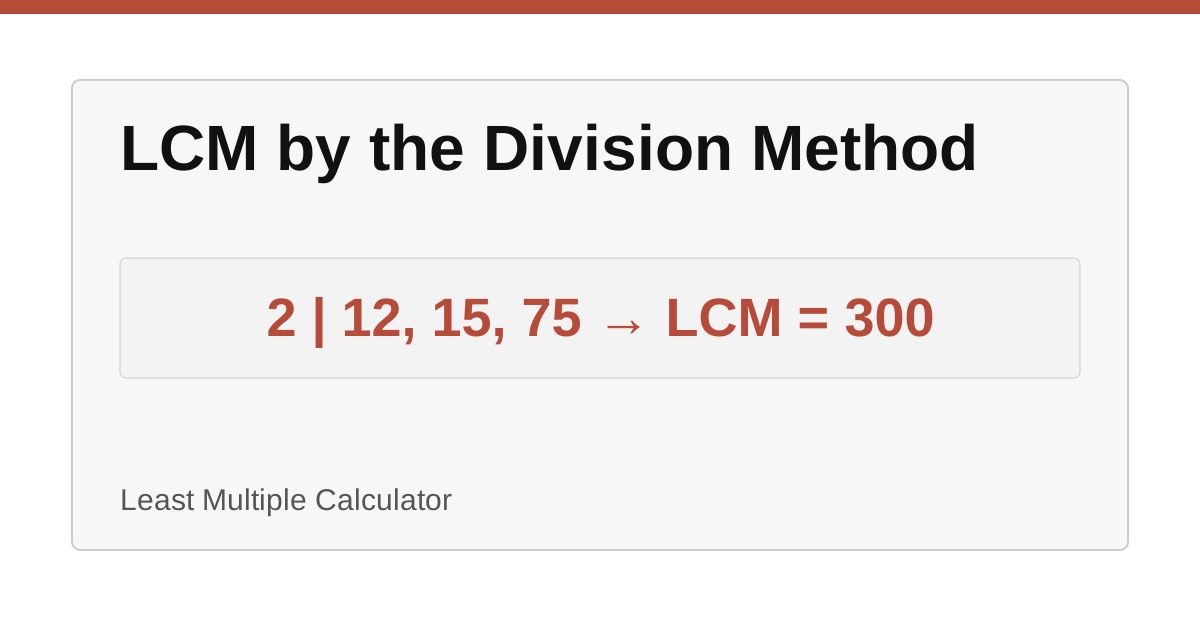
LCM by the division (ladder) method: write the numbers in a row, divide the row by the smallest prime that goes into at least one number, carry the rest down, and repeat until every number is 1. The LCM is the product of the divisors. LCM(12, 15, 75) = 2 × 2 × 3 × 5 × 5 = 300.
The division method is also called the common division method (India), the ladder method or the cake method (United States). It is the layout used in NCERT class 5 and class 6 textbooks and in most exam working. It gives the same answer as prime factorization, arranged as a table. All four methods are compared on How to find the LCM.
LCM by the division method: steps
- Write the numbers side by side with a vertical line to their left.
- Find the smallest prime that divides at least one of the numbers. Write it on the left.
- Divide every number that prime goes into; copy the others down unchanged.
- Repeat with the new row until every number is 1.
- Multiply all the primes on the left. The product is the LCM.
Worked example: LCM of 12, 15 and 75
Division method: LCM(12, 15, 75)
Divide the row by the smallest prime that goes into at least one number; carry the rest down. Keep going until every number becomes 1. The LCM is the product of all the divisors on the left.
| 2 | 12 | 15 | 75 |
|---|---|---|---|
| 2 | 6 | 15 | 75 |
| 3 | 3 | 15 | 75 |
| 5 | 1 | 5 | 25 |
| 5 | 1 | 1 | 5 |
| 1 | 1 | 1 |
LCM = 2 × 2 × 3 × 5 × 5 = 2² × 3 × 5² = 300
LCM(12, 15, 75) = 300
Greyed numbers were carried down because the divisor on that row did not go into them. The product of the divisors equals 2² × 3 × 5², the prime factorization of the LCM.
Worked example with two numbers: 8 and 12
Division method: LCM(8, 12)
Divide the row by the smallest prime that goes into at least one number; carry the rest down. Keep going until every number becomes 1. The LCM is the product of all the divisors on the left.
| 2 | 8 | 12 |
|---|---|---|
| 2 | 4 | 6 |
| 2 | 2 | 3 |
| 3 | 1 | 3 |
| 1 | 1 |
LCM = 2 × 2 × 2 × 3 = 2³ × 3 = 24
LCM(8, 12) = 24
Worked example with three numbers: 15, 20 and 30
Division method: LCM(15, 20, 30)
Divide the row by the smallest prime that goes into at least one number; carry the rest down. Keep going until every number becomes 1. The LCM is the product of all the divisors on the left.
| 2 | 15 | 20 | 30 |
|---|---|---|---|
| 2 | 15 | 10 | 15 |
| 3 | 15 | 5 | 15 |
| 5 | 5 | 5 | 5 |
| 1 | 1 | 1 |
LCM = 2 × 2 × 3 × 5 = 2² × 3 × 5 = 60
LCM(15, 20, 30) = 60
Three or more numbers add columns, not steps. More examples: LCM of 3 or more numbers.
Division method for the HCF
The same table finds the HCF (GCF) with one change: divide only by primes that go into every number, and stop when no prime does. For 12, 15 and 75 the only such prime is 3, so HCF = 3. The calculator's "cake / ladder" view shows this shared-divisor form; the difference between the two is explained on LCM vs HCF.
Common mistakes
- Stopping when no prime divides all the numbers. For the LCM, continue until every entry is 1.
- Dividing a number that the prime does not go into. 15 ÷ 2 is not a whole number; 15 is carried down.
- Forgetting to multiply the leftover row in the shared-divisor (cake) version.
Frequently asked questions
How do you find the LCM by the division method?
Write the numbers in a row. Divide by the smallest prime that divides at least one of them; copy the others down unchanged. Repeat until every entry is 1. Multiply all the divisors on the left. For 12, 15 and 75 the divisors are 2, 2, 3, 5, 5, and their product is 300.
What is the difference between the division method and the ladder method?
They are the same method with different names. India and the UK say division method or common division method; the United States says ladder method or cake method. The table and the answer are identical.
Is the division method the same as long division?
No. Long division divides one number by another. The division method for the LCM divides a whole row of numbers by one prime at a time and keeps the quotients in a table.
Which class learns the LCM by division method?
In India the division method is taught in class 5 and class 6 (NCERT, "Playing with Numbers"). In the United States the ladder method appears in grade 6.
Can the division method find the HCF too?
Yes. Divide only by primes that go into every number in the row and stop when no prime divides all of them. The product of those divisors is the HCF. The cake method on the calculator shows this shared-divisor version.
Sources
- Wikipedia: Least common multiple: definition, notation, LCM × GCD = a × b
- Wolfram MathWorld: Least Common Multiple: formal properties
- Common Core 6.NS.B.4: GCF and LCM in grade 6