How to Find the LCM of 3 or More Numbers
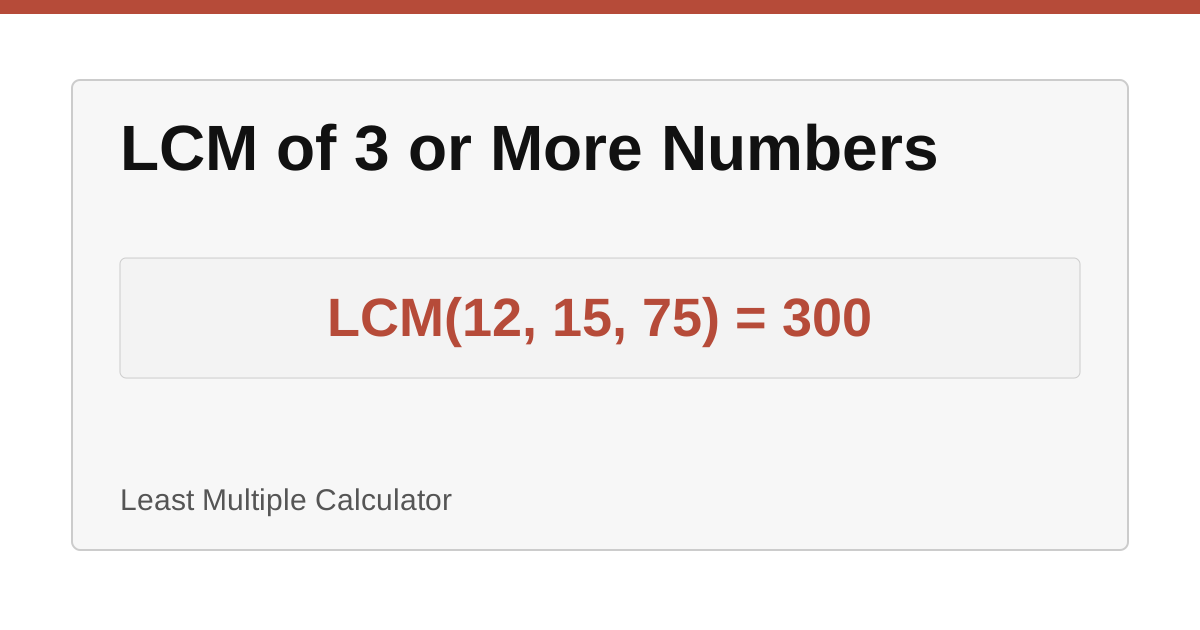
How to find the LCM of 3 or more numbers: factor every number into primes, take each prime at its highest power across all the numbers, and multiply. LCM(4, 5, 6) = 2² × 3 × 5 = 60. The division method and the pairwise GCF formula give the same answer.
Three numbers change nothing about the methods on How to find the LCM; they add a column to the table or a step to the chain. The LCM calculator takes up to 15 numbers.
Method 1: Prime factorization for 3 numbers
Prime factorization: LCM(4, 5, 6)
Break each number into prime factors.
- 4 = 2 × 2 = 2²
- 5 = 5
- 6 = 2 × 3
Take the highest power of every prime that appears, then multiply them together.
| Prime | Highest power | From |
|---|---|---|
| 2 | 2² | 4 |
| 3 | 3 | 6 |
| 5 | 5 | 5 |
LCM = 2² × 3 × 5 = 60
LCM(4, 5, 6) = 60
Full method page: prime factorisation.
How to find the LCM of 3 numbers by the division method
The division method / ladder method uses one column per number. Divide by the smallest prime that goes into at least one entry, carry the rest down, and continue until every column reads 1.
Division method: LCM(8, 9, 12)
Divide the row by the smallest prime that goes into at least one number; carry the rest down. Keep going until every number becomes 1. The LCM is the product of all the divisors on the left.
| 2 | 8 | 9 | 12 |
|---|---|---|---|
| 2 | 4 | 9 | 6 |
| 2 | 2 | 9 | 3 |
| 3 | 1 | 9 | 3 |
| 3 | 1 | 3 | 1 |
| 1 | 1 | 1 |
LCM = 2 × 2 × 2 × 3 × 3 = 2³ × 3² = 72
LCM(8, 9, 12) = 72
Method 3: Chain the GCF formula
LCM(a, b) = a × b ÷ GCF(a, b) works for two numbers at a time. For three numbers, find the LCM of the first two, then the LCM of that result and the third.
- GCF(8, 9) = 1, so LCM = 8 × 9 ÷ 1 = 72
- GCF(72, 12) = 12, so LCM = 72 × 12 ÷ 12 = 72
LCM(8, 9, 12) = 72. The order of pairing does not change the answer.
Three-digit numbers: LCM of 125, 150 and 200
Prime factorization: LCM(125, 150, 200)
Break each number into prime factors.
- 125 = 5 × 5 × 5 = 5³
- 150 = 2 × 3 × 5 × 5 = 2 × 3 × 5²
- 200 = 2 × 2 × 2 × 5 × 5 = 2³ × 5²
Take the highest power of every prime that appears, then multiply them together.
| Prime | Highest power | From |
|---|---|---|
| 2 | 2³ | 200 |
| 3 | 3 | 150 |
| 5 | 5³ | 125 |
LCM = 2³ × 3 × 5³ = 3,000
LCM(125, 150, 200) = 3,000
How to find the LCM of 3 or more numbers: four, five and beyond
The same three methods extend to any count. LCM(2, 3, 4, 5, 6, 7) = 420: the highest powers are 2², 3, 5 and 7, and 4 × 3 × 5 × 7 = 420. Enter up to 15 numbers in the calculator to see the full table.
A rule that stops working with three numbers
For two numbers, LCM × HCF = a × b. For three numbers the rule fails: LCM(4, 5, 6) × HCF(4, 5, 6) = 60 × 1 = 60, but 4 × 5 × 6 = 120. Use prime factorization or the division method instead; see LCM vs HCF.
Frequently asked questions
How do you find the LCM of 3 numbers?
Factor each number into primes, take every prime at its highest power, and multiply. LCM(4, 5, 6): 4 = 2², 5 = 5, 6 = 2 × 3, so LCM = 2² × 3 × 5 = 60.
How do you find the LCM of 3 numbers by the division method?
Write all three numbers in a row. Divide by the smallest prime that goes into at least one of them, carry the others down, and repeat until every entry is 1. Multiply the divisors on the left. The table has three columns instead of two.
Does LCM(a, b) × GCF(a, b) = a × b work for three numbers?
No. The product rule holds for two numbers only. For three or more numbers, use prime factorization, the division method, or apply the GCF formula pairwise: LCM(a, b, c) = LCM(LCM(a, b), c).
How do you find the LCM of 3 different numbers?
The method is the same whether the numbers are different or repeated. LCM(8, 9, 12) = 72: 8 = 2³, 9 = 3², 12 = 2² × 3, highest powers 2³ × 3² = 72.
How do you find the LCM of 3-digit numbers?
Use prime factorization or the division method; listing multiples is too slow. LCM(125, 150, 200): 125 = 5³, 150 = 2 × 3 × 5², 200 = 2³ × 5², so LCM = 2³ × 3 × 5³ = 3,000.
Can the calculator take more than 3 numbers?
Yes. The LCM calculator takes up to 15 numbers separated by spaces or commas and shows the working for all of them. LCM(2, 3, 4, 5, 6, 7) = 420.
Sources
- Wikipedia: Least common multiple: definition, notation, LCM × GCD = a × b
- Wolfram MathWorld: Least Common Multiple: formal properties
- Common Core 6.NS.B.4: GCF and LCM in grade 6