LCM by Prime Factorization Method
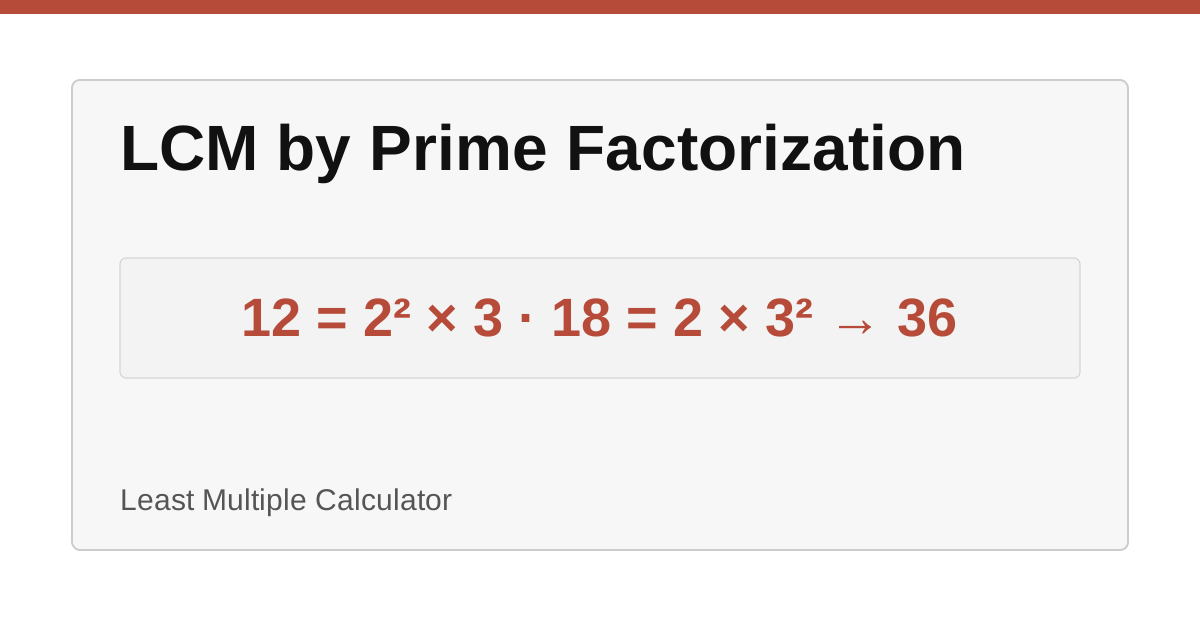
LCM by prime factorization method: write each number as a product of primes, take every prime at its highest power, and multiply those powers together. LCM(12, 15, 75) = 2² × 3 × 5² = 300.
Prime factorization (prime factorisation in UK and Indian spelling) is the method that works for any count of numbers and any size. The LCM calculator shows this working for the numbers you enter; the hub page How to find the LCM compares it with the other three methods.
LCM by prime factorization method: the three steps
- Factor each number into primes. Divide by 2 as many times as possible, then 3, then 5, and so on. A factor tree gives the same result.
- Select each prime that appears in any number, at the highest power it reaches in any single number.
- Multiply the selected powers. The product is the LCM.
Worked example: LCM of 12, 15 and 75
Prime factorization: LCM(12, 15, 75)
Break each number into prime factors.
- 12 = 2 × 2 × 3 = 2² × 3
- 15 = 3 × 5
- 75 = 3 × 5 × 5 = 3 × 5²
Take the highest power of every prime that appears, then multiply them together.
| Prime | Highest power | From |
|---|---|---|
| 2 | 2² | 12 |
| 3 | 3 | 12, 15, 75 |
| 5 | 5² | 75 |
LCM = 2² × 3 × 5² = 300
LCM(12, 15, 75) = 300
Worked example: LCM of 21, 14 and 38
Prime factorization: LCM(21, 14, 38)
Break each number into prime factors.
- 21 = 3 × 7
- 14 = 2 × 7
- 38 = 2 × 19
Take the highest power of every prime that appears, then multiply them together.
| Prime | Highest power | From |
|---|---|---|
| 2 | 2 | 14, 38 |
| 3 | 3 | 21 |
| 7 | 7 | 21, 14 |
| 19 | 19 | 38 |
LCM = 2 × 3 × 7 × 19 = 798
LCM(21, 14, 38) = 798
No prime repeats within a number here, so every power is 1 and the LCM is the product of the distinct primes: 2 × 3 × 7 × 19 = 798.
What is the LCM of 25, 30 and 40 by prime factorization?
Prime factorization: LCM(25, 30, 40)
Break each number into prime factors.
- 25 = 5 × 5 = 5²
- 30 = 2 × 3 × 5
- 40 = 2 × 2 × 2 × 5 = 2³ × 5
Take the highest power of every prime that appears, then multiply them together.
| Prime | Highest power | From |
|---|---|---|
| 2 | 2³ | 40 |
| 3 | 3 | 30 |
| 5 | 5² | 25 |
LCM = 2³ × 3 × 5² = 600
LCM(25, 30, 40) = 600
Why the method works
The fundamental theorem of arithmetic states that every whole number greater than 1 has exactly one prime factorization. A common multiple of 12, 15 and 75 must contain at least 2², at least one 3, and at least 5², or one of the three numbers would not divide it. The smallest number that meets all three conditions is 2² × 3 × 5² = 300. Any smaller number misses a required prime power.
Highest powers give the LCM; lowest powers give the GCF
The same factorizations give the greatest common factor when the lowest shared power of each prime is taken instead. For 12, 15 and 75 the only prime in all three numbers is 3, so GCF = 3. The Venn diagram method lays both out in one picture.
Common mistakes
- Taking the lowest power (gives the GCF, not the LCM).
- Adding exponents from different numbers: 2² from 12 and 2¹ from another number gives 2², not 2³.
- Stopping a factorization at a composite number: 75 = 3 × 25 must continue to 3 × 5 × 5.
Frequently asked questions
How do you find the LCM using prime factorization?
Factor each number into primes, take every prime at its highest power, and multiply. 12 = 2² × 3, 15 = 3 × 5, 75 = 3 × 5², so LCM = 2² × 3 × 5² = 300.
Why does prime factorization give the LCM?
Every whole number above 1 has exactly one prime factorization (the fundamental theorem of arithmetic). A common multiple must contain every prime of every number at least as many times as that number does. Taking each prime at its highest power gives the smallest such number.
What is the LCM of 25, 30 and 40 by prime factorization?
25 = 5², 30 = 2 × 3 × 5, 40 = 2³ × 5. Highest powers: 2³ × 3 × 5² = 600. LCM(25, 30, 40) = 600.
How do I check my prime factorization working?
Multiply the factors back: 2 × 2 × 3 = 12 confirms 12 = 2² × 3. Then divide the LCM by each original number; every division must be exact. 300 ÷ 12 = 25, 300 ÷ 15 = 20, 300 ÷ 75 = 4.
Does prime factorization work for more than two numbers?
Yes. Factor every number, then take each prime at its highest power across all of them. The method does not change with the count of numbers, which is why the calculator uses it for up to 15 numbers.
Sources
- Wikipedia: Least common multiple: definition, notation, LCM × GCD = a × b
- Wolfram MathWorld: Least Common Multiple: formal properties
- Common Core 6.NS.B.4: GCF and LCM in grade 6