Clear Fractions from an Equation Using the LCM
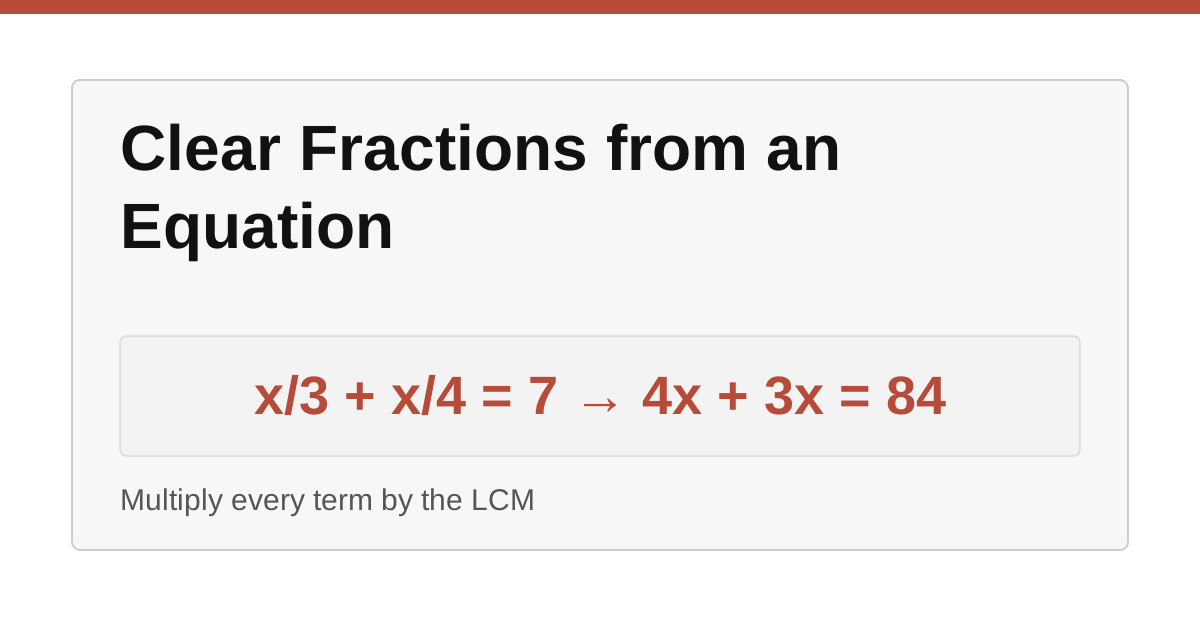
To clear fractions from an equation, multiply every term on both sides by the least common multiple (LCM) of the denominators. Each denominator divides the LCM exactly, so every fraction turns into a whole number, and the equation keeps the same solution.
The method has 4 steps:
- List the denominators of every fraction in the equation.
- Find the LCM of those denominators. This number is the least common denominator (LCD).
- Multiply every term on both sides by the LCD, including terms without a fraction.
- Solve the whole-number equation, then check the answer in the original equation.
Why Does Multiplying an Equation by the LCM Keep the Same Solution?
Multiplying both sides of an equation by the same nonzero number keeps the solution, because both sides change by the same factor. This rule is the multiplication property of equality. The LCM is one such nonzero number, chosen because it cancels every denominator at once.
For x/3 + x/4 = 7, the LCM of 3 and 4 is 12:
- 12 × (x/3) = 4x
- 12 × (x/4) = 3x
- 12 × 7 = 84
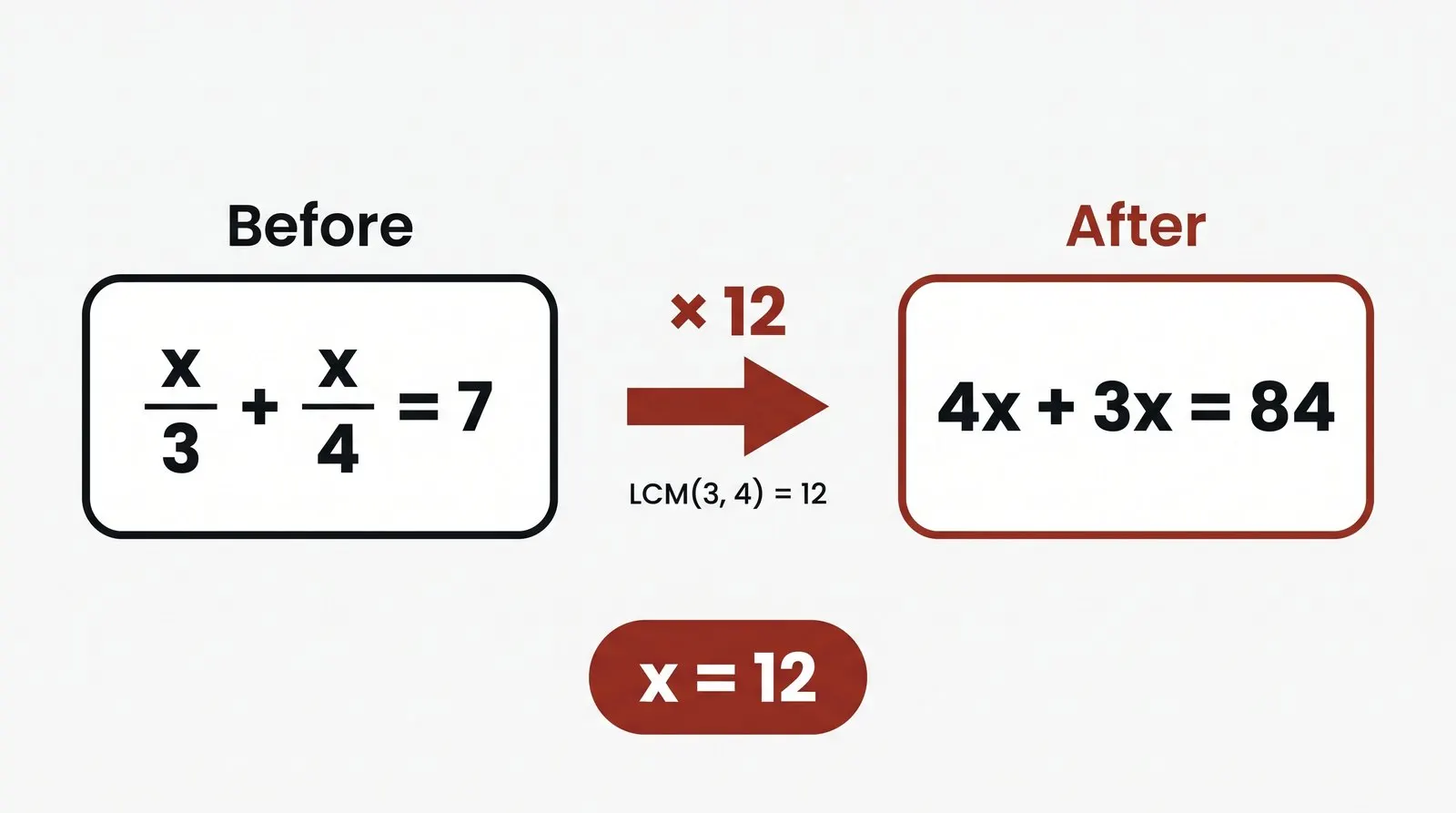
The new equation, 4x + 3x = 84, has no fractions. It gives 7x = 84, so x = 12. The check in the original equation confirms the answer: 12/3 + 12/4 = 4 + 3 = 7.
Any common multiple of the denominators clears the fractions; 24 works for this equation as well. The LCM keeps the coefficients smallest, so less simplifying remains at the end.
Can You Multiply an Expression by the LCM the Same Way?
No, an expression without an equals sign cannot be multiplied by the LCM, because there is no second side to balance the change. Multiplying 1/2 + 1/3 by 6 gives 5, which is a different value from 5/6.
An expression takes the LCM in a different role: as the common denominator. Each fraction is multiplied by a form of 1, such as 3/3 or 2/2:
- 1/2 = 3/6
- 1/3 = 2/6
- 1/2 + 1/3 = 3/6 + 2/6 = 5/6
The table below separates the 2 situations by what the LCM does and what the result looks like.
| Situation | Role of the LCM | Result |
|---|---|---|
| Equation: x/3 + x/4 = 7 | Multiplies both sides | 4x + 3x = 84, no fractions |
| Expression: 1/2 + 1/3 | Becomes the common denominator | 5/6, still a fraction |
How Do You Clear Fractions When Every Term Is Not a Fraction?
Multiply every term by the LCM, including the whole-number terms, because the multiplication applies to the entire side. The equation 2/3 − 3y/2 + y/3 + 4 = 0 has denominators 3, 2 and 3, so the LCM is 6:
- 6 × (2/3) = 4
- 6 × (3y/2) = 9y
- 6 × (y/3) = 2y
- 6 × 4 = 24
- 6 × 0 = 0
The cleared equation is 4 − 9y + 2y + 24 = 0. Combining like terms gives 28 − 7y = 0, so y = 4. The check confirms the answer: 2/3 − 6 + 4/3 + 4 = 0.
How Do You Clear Fractions with Binomial Numerators?
Put each numerator in parentheses before multiplying, so the LCM factor reaches every term of the numerator. The equation (x − 1)/2 − (x + 3)/5 = 1 has denominators 2 and 5, so the LCM is 10:
- 10 × (x − 1)/2 = 5(x − 1) = 5x − 5
- 10 × (x + 3)/5 = 2(x + 3) = 2x + 6
- 10 × 1 = 10
The subtraction sign applies to the whole second numerator: 5x − 5 − (2x + 6) = 10. The equation becomes 3x − 11 = 10, so x = 7. The check confirms the answer: 6/2 − 10/5 = 3 − 2 = 1.
What Are the 2 Most Common Mistakes When Clearing Fractions?
The 2 most common mistakes are skipping the whole-number terms and dropping the parentheses around a numerator. Both mistakes produce a wrong answer that looks reasonable.
Skipping whole-number terms: in 2/3 − 3y/2 + y/3 + 4 = 0, multiplying the fractions by 6 but leaving the 4 unchanged gives 8 − 7y = 0 and y = 8/7, which fails the check.
Dropping the parentheses: in (x − 1)/2 − (x + 3)/5 = 1, writing −2x + 6 instead of −2x − 6 gives 3x + 1 = 10 and x = 3. The check fails: 2/2 − 6/5 = −1/5, not 1.
A check in the original equation catches both mistakes in under a minute.
Clearing fractions from an equation takes one step with the LCM: multiply every term on both sides by the least common multiple of the denominators.
Least Multiple Calculator: find the LCM of up to 15 denominators with the working shown.
Frequently asked questions
Is clearing fractions the same as finding a common denominator?
No, clearing fractions removes the denominators from an equation, while finding a common denominator keeps the fractions in an expression. Both use the LCM of the denominators, as shown in LCM of Fractions.
Does clearing fractions work with variables in the denominator?
Yes, clearing fractions works with variable denominators, as long as the variable is not 0. The LCM of the denominators becomes an algebraic expression, and every solution must be checked, because a value that makes a denominator 0 is not allowed.
Which number clears the fractions fastest?
The LCM of the denominators clears the fractions fastest, because it is the smallest number that every denominator divides. The Least Multiple Calculator finds the LCM of up to 15 denominators and shows the working.
Sources
- Wikipedia: Least common multiple: definition, notation, LCM × GCD = a × b
- Wolfram MathWorld: Least Common Multiple: formal properties
- Common Core 6.NS.B.4: GCF and LCM in grade 6