Adding Fractions With Unlike Denominators
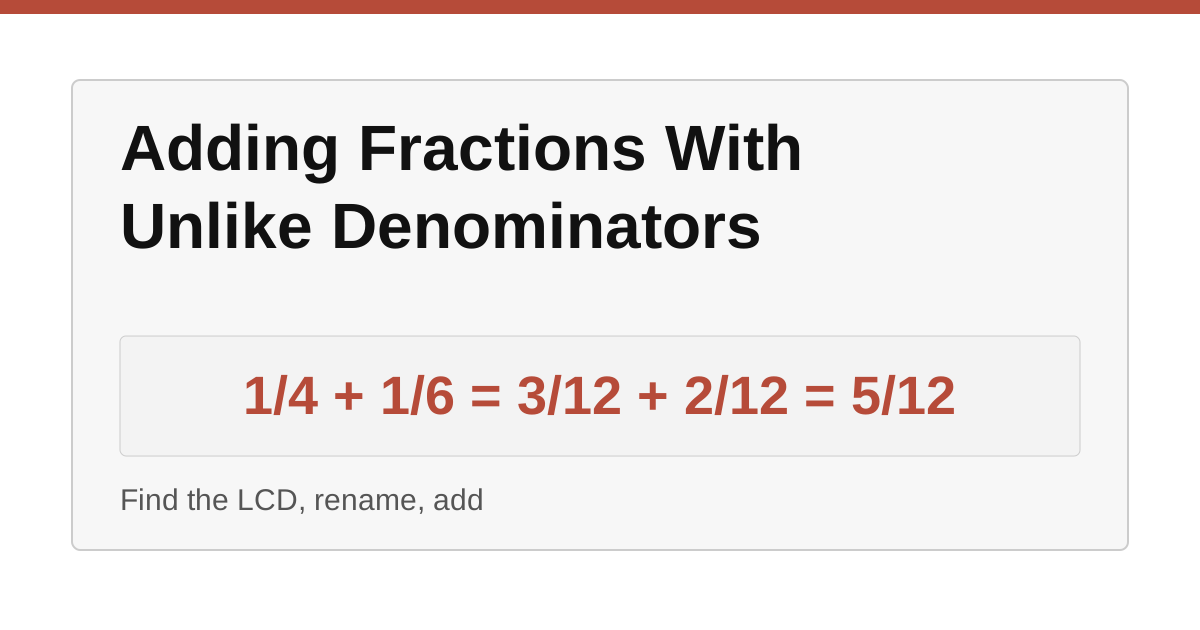
Adding fractions with unlike denominators takes 4 steps: find the least common denominator (the LCM of the denominators), rename each fraction to it, add the numerators and simplify. 1/4 + 1/6 = 3/12 + 2/12 = 5/12.
Why Do Unlike Denominators Need a Common Denominator?
A denominator says how big the pieces are, so fractions can only be added once their pieces are the same size. Quarters and sixths are different sizes; both become twelfths, and twelfths can be counted together.
How to Add Fractions With Unlike Denominators in 4 Steps
- Find the LCD: the LCM of 4 and 6 is 12.
- Rename each fraction: 1/4 = 3/12 (× 3); 1/6 = 2/12 (× 2).
- Add the numerators: 3 + 2 = 5, over 12.
- Simplify: 5/12 is already in lowest terms.
The LCD step is the LCM of the denominators; the Least Common Denominator Calculator finds it, with the steps, for any list of fractions.
Adding Fractions With Unlike Denominators: 5 Worked Examples
| Sum | LCD | Renamed | Answer |
|---|---|---|---|
| 1/4 + 1/6 | 12 | 3/12 + 2/12 = 5/12 | 5/12 |
| 2/3 + 3/5 | 15 | 10/15 + 9/15 = 19/15 | 1 4/15 (19/15) |
| 5/6 + 7/8 | 24 | 20/24 + 21/24 = 41/24 | 1 17/24 (41/24) |
| 3/10 + 4/15 | 30 | 9/30 + 8/30 = 17/30 | 17/30 |
| 1/2 + 1/3 + 1/4 | 12 | 6/12 + 4/12 + 3/12 = 13/12 | 1 1/12 (13/12) |
Three fractions work the same way: the LCD is the LCM of all three denominators, here 12 for 2, 3 and 4.
Adding Mixed Numbers With Unlike Denominators
Write each mixed number as an improper fraction, add with the LCD, then write the answer as a mixed number.
- 2 1/3 = 7/3 and 1 3/4 = 7/4
- LCD of 3 and 4 = 12: 7/3 = 28/12, 7/4 = 21/12
- 28/12 + 21/12 = 49/12 = 4 1/12
Subtracting Fractions With Unlike Denominators
Subtracting uses the same LCD; only the last step changes from adding to subtracting the numerators. 5/6 − 1/4: LCD 12, so 10/12 − 3/12 = 7/12.
Common Mistakes When Adding Fractions
- Adding the denominators: 1/4 + 1/6 ≠ 2/10. The denominator stays the LCD; only the numerators are added.
- Renaming only the bottom: multiply the numerator by the same number as the denominator, or the fraction changes value.
- Using the product when the LCD is smaller: 4 × 6 = 24 works but leaves a bigger fraction to simplify; the LCD is 12.
- Forgetting to simplify: divide the answer by the GCF of its top and bottom.
Why the LCM gives the least common denominator, and how it works for fractions and decimals, is on LCM of Fractions.
Least Multiple Calculator: the LCM of any denominators, worked out six ways.
Frequently asked questions
How do you add fractions with unlike denominators?
Find the LCD (the LCM of the denominators), rename each fraction to that denominator, add the numerators and simplify. 1/4 + 1/6: LCD 12, 3/12 + 2/12 = 5/12.
Do you have to use the least common denominator?
No; any common denominator works, such as the product of the denominators. For 1/4 + 1/6 that is 24, and you simplify more at the end. The LCD keeps the numbers smallest.
How do you find the LCD of two fractions?
Take the LCM of the denominators. For 5/6 and 7/8 the LCM of 6 and 8 is 24. The Least Common Denominator Calculator does it for any number of fractions.
How do you add mixed numbers with unlike denominators?
Turn each mixed number into an improper fraction, add as usual, then turn the answer back: 2 1/3 + 1 3/4 = 7/3 + 7/4 = 49/12 = 4 1/12.
Is subtracting fractions with unlike denominators the same?
Yes. Use the same LCD and subtract the renamed numerators: 5/6 − 1/4 = 10/12 − 3/12 = 7/12.
Why can you not just add the tops and the bottoms?
Because the pieces are different sizes. 1/4 + 1/6 is not 2/10: 5/12 is the correct sum, and 2/10 is smaller than 1/4 alone.
Sources
- Wikipedia: Least common multiple: definition, notation, LCM × GCD = a × b
- Wolfram MathWorld: Least Common Multiple: formal properties
- Common Core 6.NS.B.4: GCF and LCM in grade 6