LCM of Polynomials and Algebraic Expressions
To find the LCM of polynomials, factor each expression completely, take every distinct factor at the highest power it reaches in any one expression, and multiply. LCM(x² − 4, x² + 4x + 4) = (x − 2)(x + 2)².
The rule is the prime-factorization rule from How to find the LCM, with polynomial factors in place of primes. Numbers in the coefficients still use the ordinary LCM calculator.
Monomials: LCM with variables and exponents
A monomial is a coefficient times variables with exponents. Take the numeric LCM of the coefficients and each variable at its highest exponent.
- LCM(6x²y, 4xy³): coefficients LCM(6, 4) = 12; x² beats x; y³ beats y → 12x²y³.
- LCM(8a³b, 12a²b⁴): LCM(8, 12) = 24; a³; b⁴ → 24a³b⁴.
- LCM(5p, 7q): LCM(5, 7) = 35; p and q each once → 35pq.
LCM of polynomials: factor first
Factor by the usual routes: common factor, difference of squares, perfect-square trinomial, general trinomial. Then apply the highest-power rule.
| Expressions | Factored | LCM |
|---|---|---|
| x² − 4 and x² + 4x + 4 | (x − 2)(x + 2) and (x + 2)² | (x − 2)(x + 2)² |
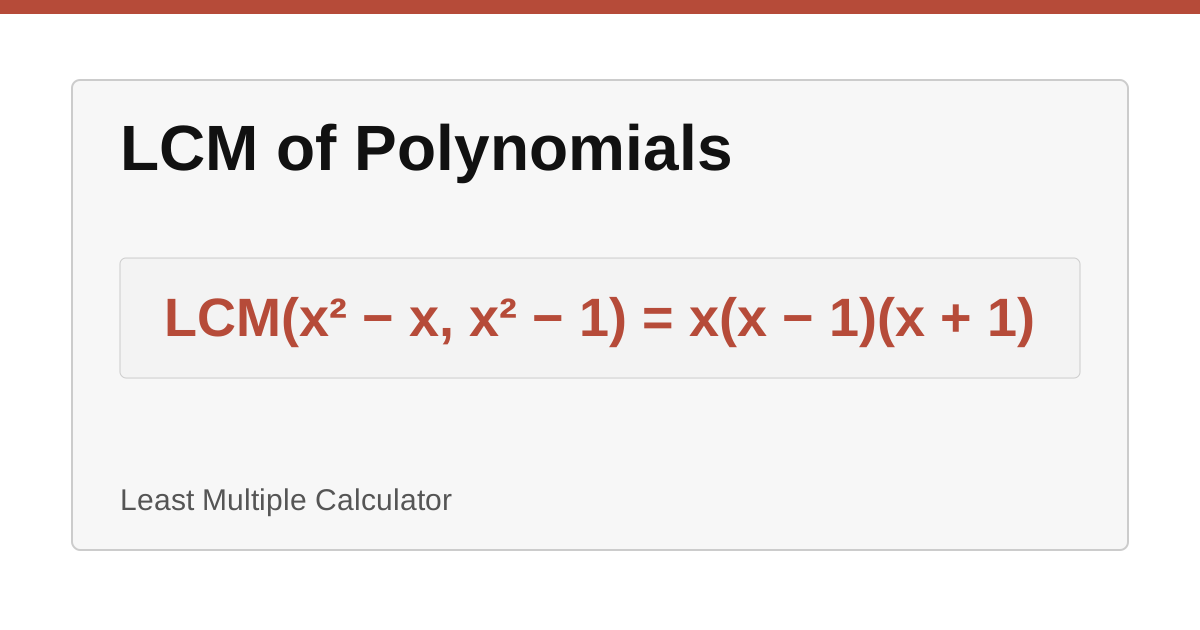
| x² − x and x² − 1 | x(x − 1) and (x − 1)(x + 1) | x(x − 1)(x + 1) |
| 3x + 6 and x² + 5x + 6 | 3(x + 2) and (x + 2)(x + 3) | 3(x + 2)(x + 3) |
| 2x² − 8 and 4x + 8 | 2(x − 2)(x + 2) and 4(x + 2) | 4(x − 2)(x + 2) |
Worked example: LCM of x² − x and x² − 1
- x² − x = x(x − 1).
- x² − 1 = (x − 1)(x + 1).
- Distinct factors: x, (x − 1), (x + 1), each at power 1.
- LCM = x(x − 1)(x + 1). Check: both expressions divide it exactly.
HCF of polynomials
The HCF (GCF) takes the shared factors at their lowest power. For x² − 4 and x² + 4x + 4 the shared factor is (x + 2) at power 1, so HCF = x + 2. As with numbers, HCF × LCM = product of the two expressions. The number version is on LCM vs HCF.
Rational expressions: the LCD
To add 1/(x² − x) + 1/(x² − 1), the lowest common denominator is the LCM of the denominators, x(x − 1)(x + 1). Rewrite each fraction over it, then add the numerators: (x + 1) + x = 2x + 1, so the sum is (2x + 1) ÷ [x(x − 1)(x + 1)]. For number denominators use the Least Common Denominator Calculator.
Common mistakes
- Multiplying the two polynomials without factoring: (x² − 4)(x² + 4x + 4) is a common multiple, not the least.
- Taking a shared factor once when one expression has it squared: (x + 2)² must keep the square.
- Forgetting the numeric coefficient: LCM(4x², 6xy) is 12x²y, not x²y.
Frequently asked questions
How do you find the LCM of polynomials?
Factor each polynomial completely, list every distinct factor, take each factor at the highest power it reaches in any one polynomial, and multiply. LCM(x² − 4, x² + 4x + 4) = (x − 2)(x + 2)².
How do you find the LCM with variables?
Treat each variable like a prime. For 6x²y and 4xy³: numbers LCM(6, 4) = 12, x at the higher power x², y at the higher power y³, so LCM = 12x²y³.
How do you find the LCM with variables and exponents?
Take the numeric LCM of the coefficients, then each variable at its highest exponent. LCM(8a³b, 12a²b⁴) = 24a³b⁴.
How do you find the HCF and LCM of polynomials?
Both start from the factorizations. The HCF takes the shared factors at their lowest power; the LCM takes every factor at its highest power. For x² − 4 and x² + 4x + 4: HCF = x + 2, LCM = (x − 2)(x + 2)².
How do you find the LCM of rational expressions?
The LCM of the denominators is the lowest common denominator (LCD). Factor each denominator, then take every factor at its highest power. 1/(x² − x) + 1/(x² − 1) has LCD x(x − 1)(x + 1).
How do you find the LCM of algebraic expressions in class 8?
The same three steps as for numbers: factorise (common factor, difference of squares, trinomials), take the highest power of each factor, multiply. Textbook example: LCM(4x², 6xy) = 12x²y.
Sources
- Wikipedia: Least common multiple: definition, notation, LCM × GCD = a × b
- Wolfram MathWorld: Least Common Multiple: formal properties
- Common Core 6.NS.B.4: GCF and LCM in grade 6