LCM Edge Cases: One Number, Zero, Negatives
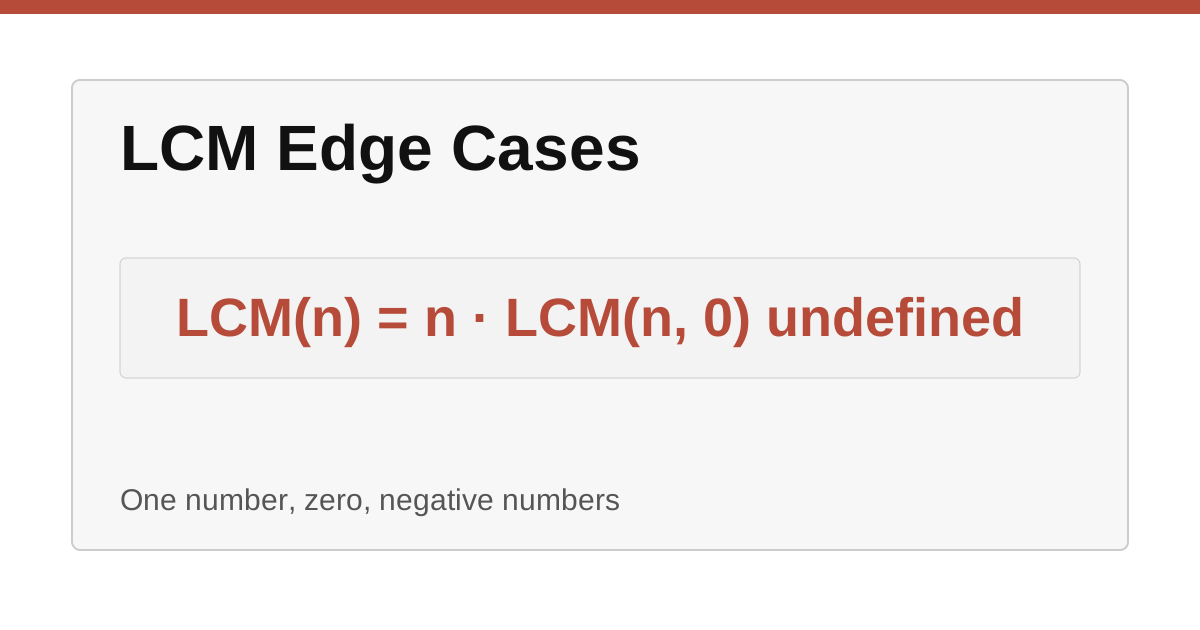
- One number
- Zero
- Negative
The least common multiple (LCM) has 3 edge cases: a single number, the number 0, and negative numbers. Each case follows from the definition: the LCM of a set of integers is the smallest positive integer that every member of the set divides.
What Are the 3 Edge Cases of the LCM?
The 3 edge cases produce 3 fixed answers:
| Edge case | Answer | Why |
|---|---|---|
| One number | LCM(n) = n | n is the smallest positive integer that n divides |
| Zero | LCM(n, 0) is undefined | 0 has no positive multiple |
| Negative numbers | LCM(−a, b) = LCM(a, b) | the LCM uses absolute values |
What Is the LCM of One Number?
The LCM of one number is the number itself: LCM(n) = n. The number n is the smallest positive integer that n divides, so the definition returns n without further calculation. LCM(12) = 12, LCM(7) = 7, and LCM(250) = 250.
The multiples of one number form the sequence n, 2n, 3n, 4n, and so on. A program that lists the multiples of one number needs a loop that multiplies n by successive integers, not an LCM routine.
Is 0 a Multiple of Every Number?
Yes, 0 is a multiple of every integer, because n × 0 = 0 for every n. The LCM, however, excludes 0 by definition: the LCM is the smallest POSITIVE common multiple, and 0 is not positive.
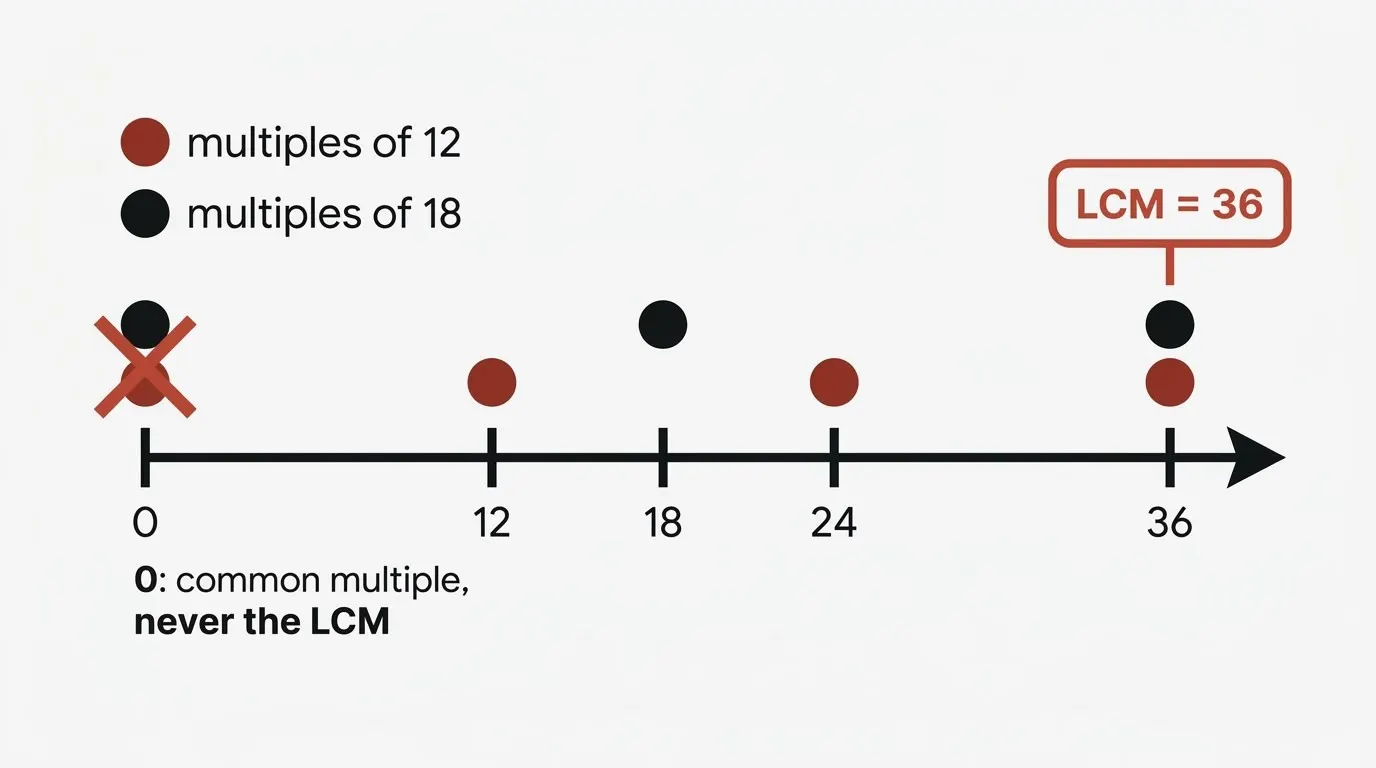
The distinction resolves the classroom confusion in 2 sentences:
- As a multiple, 0 qualifies for every number: 0 = 12 × 0 = 18 × 0.
- As an LCM candidate, 0 never qualifies, because the definition demands a positive result.
LCM(n, 0) therefore stays undefined. A calculator that accepts 0 as an input returns an error state, not a value.
How Does the LCM Treat Negative Numbers?
The LCM of negative numbers equals the LCM of their absolute values: LCM(−4, 6) = LCM(4, 6) = 12. Multiples of −4 include both negative and positive values, and the least POSITIVE common multiple of −4 and 6 remains 12. Number theory defines the LCM on absolute values, so a sign never changes the result.
The edge cases of the least common multiple — one number, zero, and negative numbers — all resolve by reading the definition exactly.
Least Multiple Calculator: find the LCM of 2 to 15 numbers with the working shown.
Frequently asked questions
Can the LCM of a set be 0?
No, the LCM of a set is never 0. The definition requires the smallest positive common multiple, and 0 is not positive.
Is every number a divisor of 0?
Yes, every nonzero integer is a divisor of 0, because 0 ÷ n = 0 with no remainder. The number 0 is not a divisor of any number, because division by 0 is undefined.
Sources
- Wikipedia: Least common multiple: definition, notation, LCM × GCD = a × b
- Wolfram MathWorld: Least Common Multiple: formal properties
- Common Core 6.NS.B.4: GCF and LCM in grade 6